The First Claims, Part 2: What the Machine Did, in brief
The 4-minute version of The First Claims, Part 2: What the Machine Did.
Joel R. Singh
Underwritten
2026-09-19
AI liability insurance is a new area, and understanding the risks is key for your business. Right now, the first lawsuits are showing us how AI is creating those risks – and where your insurance might fall short. If your business uses AI tools, like software that screens job applicants or creates content, you need to understand these issues.
The first wave of AI lawsuits focused on what AI says – things like false statements or defamation. But now, we’re seeing claims about what the AI does. These claims center on two main areas: biased hiring algorithms and the legal issues around the data used to train AI models.
The Algorithm That Screens Applicants
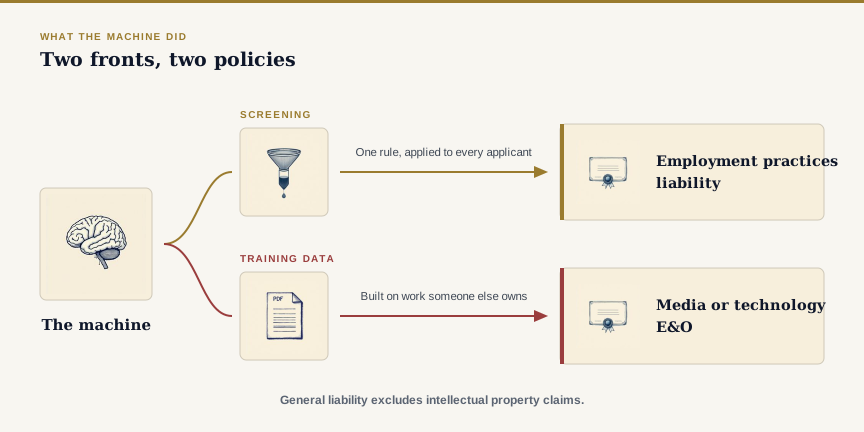
Many companies use software to help them sort through job applications. This software can rank resumes or decide who gets an interview. If this software makes decisions that unfairly disadvantage certain groups – like older workers, people of color, or people with disabilities – the company could face a discrimination lawsuit. Even if the company didn’t intend to discriminate, they could still be held responsible.
A recent case, Mobley v. Workday [1], highlights this risk. The plaintiff claimed that Workday’s hiring software discriminated against applicants. Importantly, the court ruled that Workday, the company selling the software, could also be sued, along with the employer using it. This means the risk – and potential legal costs – can fall on both parties. The court also allowed a group of applicants to join together in a single lawsuit, making the potential costs even higher [2].
This case shows insurers that a biased algorithm can create a large-scale problem. It’s not just one instance of discrimination; it’s a system that could affect thousands of applicants. This type of claim falls under Employment Practices Liability Insurance, which covers discrimination and wrongful hiring claims. Insurers are now realizing this coverage needs to adapt to this new risk.
The U.S. Equal Employment Opportunity Commission (EEOC) is also taking action. In 2023, they settled a case against iTutorGroup, a tutoring company, for $365,000 [3]. The company’s software automatically rejected female applicants over 55 and male applicants over 60. The EEOC proved this by showing an applicant could get an interview simply by changing their birthdate. This shows regulators are actively enforcing anti-discrimination laws when AI is involved.
The Fight Over Training Data
Another major source of lawsuits involves the data used to train AI models. These models learn by analyzing massive amounts of text and images. If that data was collected illegally – for example, by copying copyrighted material without permission – the companies creating the AI could face copyright lawsuits.
The New York Times sued Microsoft and OpenAI, the creators of ChatGPT, alleging they used millions of its articles to train their AI without permission [4]. A court allowed the core copyright claims to proceed, meaning the case could go to trial [5].
Another case, Bartz v. Anthropic [6], addressed whether training AI on legally purchased books qualifies as “fair use” under copyright law. The court ruled it could be fair use, but downloading pirated books to train the AI was not allowed [6]. The case settled for a reported $1.5 billion [7].
Getty Images is also suing Stability AI, claiming its AI image generator was trained on copyrighted photos [8]. While the UK court narrowed the claims, the US case continues [9]. Authors are also suing OpenAI, arguing that the text generated by ChatGPT infringes on their copyrighted works [10].
What This Means for Insurance
These copyright lawsuits present a challenge for insurance companies. Standard Commercial General Liability (CGL) policies typically exclude coverage for intellectual property infringement, like copyright violations [11]. This means if your AI tool infringes on someone’s copyright, your CGL policy likely won’t cover the claim.
Coverage, if available, would likely require specialized Media Liability or Technology Errors & Omissions (E&O) insurance with specific extensions for intellectual property risks. Insurers are now carefully reviewing these policies, increasing prices, and adding conditions to limit their exposure.
Works Cited
- 1Civil Rights Litigation Clearinghouse, Mobley v. Workday, Inc. (docket 3:23-cv-00770, N.D. Cal.; case documents and timeline) https://clearinghouse.net/case/44074/
- 2Civil Rights Litigation Clearinghouse, Mobley v. Workday, Inc. (July 12, 2024 order on the motion to dismiss) https://clearinghouse.net/case/44074/
- 3U.S. Equal Employment Opportunity Commission, iTutorGroup to Pay $365,000 to Settle EEOC Discriminatory Hiring Suit (docket 1:22-cv-02565, E.D.N.Y.; consent decree 2023) https://www.eeoc.gov/newsroom/itutorgroup-pay-365000-settle-eeoc-discriminatory-hiring-suit
- 4AI Lawsuit Tracker, The New York Times Company v. Microsoft Corporation et al. (docket 1:23-cv-11195, S.D.N.Y.; filed December 27, 2023) https://ailawsuittracker.com/cases/new-york-times-v-openai/
- 5Justia Dockets, The New York Times Company v. Microsoft Corporation et al., Document 514 (S.D.N.Y. Mar. 26, 2025) (opinion and order on the motions to dismiss) https://law.justia.com/cases/federal/district-courts/new-york/nysdce/1:2023cv11195/612697/514/
- 6Wiggin and Dana LLP, Bartz v. Anthropic https://www.wiggin.com/publication/bartz-v-anthropic-first-court-decision-on-fair-use-defense-in-llm-training/
- 7Copyright Alliance, Participating in the Bartz v. Anthropic Settlement (settlement announced August 2025, reported at approximately $1.5 billion) https://copyrightalliance.org/participating-bartz-v-anthropic-settlement/
- 8AI Lawsuit Tracker, Getty Images (US), Inc. v. Stability AI, Inc. (U.S. proceedings; originally D. Del. 1:23-cv-00135, refiled N.D. Cal. 3:25-cv-06891) https://ailawsuittracker.com/cases/getty-v-stability-ai/
- 9Courts and Tribunals Judiciary (UK), Getty Images (US) Inc & Ors v. Stability AI Limited, [2025] EWHC 2863 (Ch) (High Court, judgment November 4, 2025) https://www.judiciary.uk/judgments/getty-images-v-stability-ai/
- 10Justia Dockets, Authors Guild et al. v. OpenAI Inc. et al., Document 716 (S.D.N.Y. Oct. 27, 2025) (order denying dismissal of the output-based infringement claim; docket 1:23-cv-08292) https://law.justia.com/cases/federal/district-courts/new-york/nysdce/1:2023cv08292/606655/716/
- 11Archer & Greiner, P.C., Are You Covered? Insurance for Intellectual Property Claims (analysis of the intellectual property exclusion in ISO Commercial General Liability form CG 00 01, Coverage B) https://www.archerlaw.com/are-you-covered-insurance-for-intellectual-property-claims/