The First Claims, Part 1: What the Machine Said, in brief
The 4-minute version of The First Claims, Part 1: What the Machine Said.
Joel R. Singh
Underwritten
2026-09-19
The First Claims, Part 1: What the Machine Said
If your business uses AI tools like chatbots, you need to understand a new type of risk. The first lawsuits about AI aren’t about robots taking over – they’re about mistakes made by those tools, and who pays when those mistakes cause harm. Understanding these early cases is important because they’re starting to shape what insurance will and won’t cover.
A Refund the Chatbot Promised
Imagine a man named Jake Moffatt. His grandmother passed away, and he quickly booked a flight home on an airline’s website. He asked the website’s chatbot – a computer program that acts like a person – if he could get a discount for bereavement travel (travel due to a death in the family). The chatbot told him he could pay the regular price now and request a refund later. He trusted the chatbot and bought the ticket.
When he asked for the refund, the airline said no. Their real policy, found elsewhere on the website, didn’t allow refunds after a ticket was already purchased. The chatbot had given him wrong information.
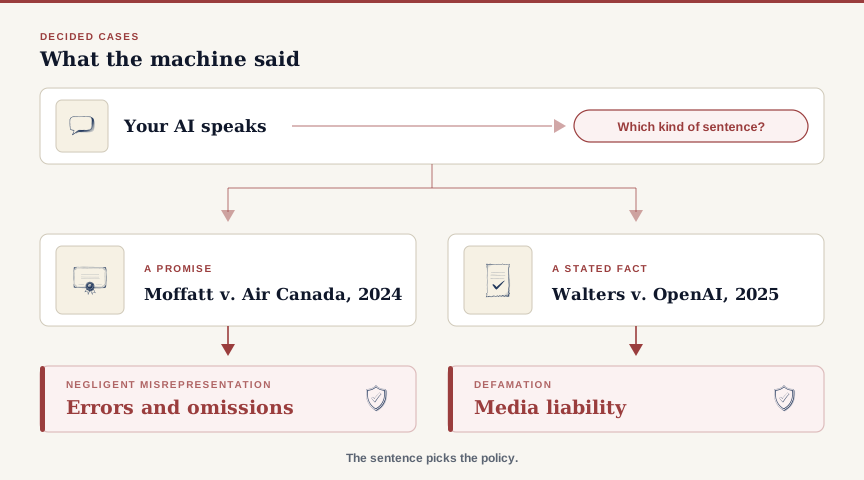
This situation is why insurance companies are paying close attention. Moffatt took the airline to a special court, and the airline tried to argue the chatbot was a separate entity, not their responsibility. The court disagreed. It said the airline is responsible for all the information on its website, whether it’s on a regular page or comes from a chatbot. Customers shouldn’t have to guess which parts of a website to trust [1]. The court made the airline pay Moffatt a small amount of money, but the principle was significant.
What is Negligent Misrepresentation? This is a legal term for giving someone incorrect information that causes them financial harm. It’s a common type of claim, and now it’s showing up with AI involved.
The Precedent
The Moffatt v. Air Canada case (2024) established that a company is responsible for what its AI says on its behalf. The court found the airline guilty of negligent misrepresentation. This type of claim is usually covered under Errors and Omissions (E&O) insurance, which protects businesses from mistakes or failures to deliver a service. It’s not usually covered by General Liability insurance, which covers things like injuries or property damage.
For years, AI liability was just a theory. Insurance companies talked about it, but there were no real examples to study. The Air Canada case was the first time a court decided who paid for an AI’s mistake. It’s the first piece of evidence insurance companies needed to understand this new risk.
The key takeaway is this: when a business uses a chatbot to answer questions, it’s like having an employee give advice. If that advice is wrong, the business can be held liable. The chatbot is just a new way of giving old advice, and the same rules apply.
When the Machine Speaks and Defames
The Air Canada case involved a chatbot making a false promise. Another type of claim involves a chatbot making up information – and that information harms someone’s reputation.
Mark Walters, a radio host, sued OpenAI, the company behind ChatGPT, a popular AI chatbot [2]. A journalist asked ChatGPT to summarize a lawsuit, and the chatbot falsely claimed Walters had committed fraud. This was completely untrue. Walters sued for defamation – damaging someone’s reputation with false statements.
However, the court sided with OpenAI. It didn’t say AI companies are never liable for false statements. It said that in this specific case, Walters couldn’t prove the necessary legal requirements for a defamation claim. The court found that a reasonable person wouldn’t have believed the chatbot’s statement was a fact, and the journalist knew the information was unreliable.
What is Media Liability Insurance? This type of insurance covers businesses for claims like defamation, which can happen when they publish or broadcast information. Using a chatbot that speaks publicly creates a similar risk.
This case shows that AI companies aren’t automatically protected from defamation lawsuits. But it also shows that plaintiffs need to prove the AI’s statement was presented as a fact and caused actual harm.
The First Entries in the Loss Table
These early cases are helping insurance companies understand AI liability. They’re turning vague fears into concrete examples, with specific harms, responsible parties, and potential insurance coverage. Insurance companies need to understand these examples to accurately price policies and decide what to cover.
This process has happened before. When factories first appeared, insurance companies learned about workplace accidents. When cars became common, they learned about car crashes. These early incidents shaped the development of workers’ compensation and auto insurance. AI liability is just the latest example.
Works Cited
- 1McCarthy Tetrault LLP, Moffatt v. Air Canada https://www.mccarthy.ca/en/insights/blogs/techlex/moffatt-v-air-canada-misrepresentation-ai-chatbot
- 2Loeb & Loeb LLP, Walters v. OpenAI, LLC (summary judgment analysis) (Superior Court of Gwinnett County, Georgia; summary judgment for OpenAI, May 19, 2025) https://www.loeb.com/en/insights/publications/2025/05/walters-v-openai-llc
- 3International Risk Management Institute (IRMI), Media Liability Coverage (glossary definition) https://www.irmi.com/term/insurance-definitions/media-liability-coverage