Who Insures the Machine, in brief
The 4-minute version of Who Insures the Machine.
Joel R. Singh
Underwritten
2026-10-17
Your business renews its insurance, and a new clause says the policy will not pay for claims caused by artificial intelligence. If you use chatbots, image generators, or software that makes decisions on its own, that clause matters. For years, business policies said nothing about AI. Now a growing number of them exclude it by name. A new insurance market has formed to fill that gap, and this brief explains who is in it and how it works.
The same thing happened with cyber risk a few years ago. Insurers added exclusions, and then a separate market grew up to sell cyber cover on its own. AI is following that path.
This market is real. Insurers have put real money behind it to pay claims. Lloyd's of London, the large insurance marketplace, has played a central part in building it. Big reinsurers, the companies that insure insurance companies, stand behind the policies. You can buy this cover today through specialist brokers. If your last renewal left AI out, you now have options.
How This Market Works
AI cover is sold differently from a typical business policy. Well-known insurers are not filing standard forms with every state. Instead, the market rests on four parts.
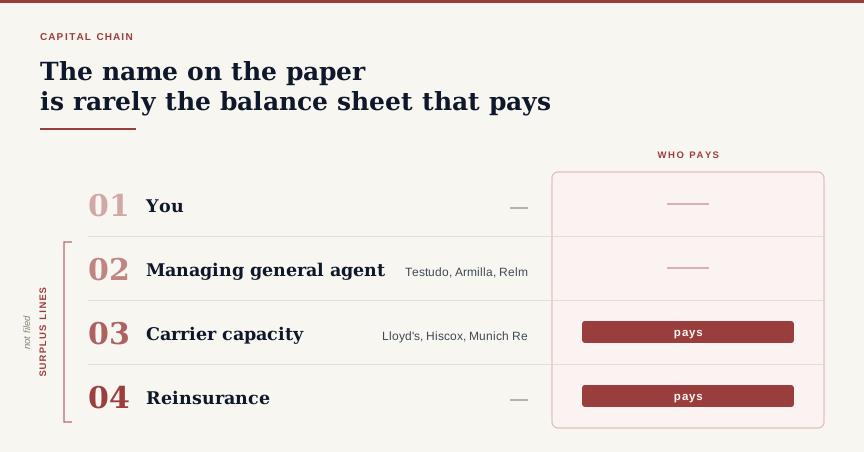
The first part is the accelerator. Lloyd's Lab is a program that helps insurance start-ups build new products. It gives them mentoring and connects them with the capital that backs policies.[1] When a company is called "Lloyd's Lab-backed," it means the Lloyd's market picked it, coached it, and linked it to that money.
The second part is the managing general agent (MGA). An MGA is a firm that an insurer allows to underwrite on its behalf. In plain terms, the MGA decides whom to insure and what to charge.[2] At Lloyd's, these firms are called coverholders.[3] The MGA brings the know-how about AI risk, and the insurer brings the money.
The third part is the surplus lines market. This corner of the industry covers risks that standard insurers will not write.[4] These risks tend to be unusual or hard to price. AI liability fits well, because there is almost no loss history to price it from. Surplus lines policies are usually not "admitted," which means they are not filed with and approved by your state's insurance department.
The fourth part is reinsurance, which is insurance for insurance companies.[5] It lets an insurer take on a large or unfamiliar risk without putting its own survival on the line. Reinsurers help absorb the biggest losses that AI claims could bring.
Who’s Offering AI Insurance?
Testudo shows the whole system at work. It is an MGA backed by Lloyd's Lab that writes AI liability cover. Its policies cover errors in AI output, privacy breaches, and legal costs when a company is sued over its AI. It offers up to $9.25 million in cover per insured, backed by several Lloyd's syndicates.[6] In August 2026, Testudo told us that limit has risen to $10 million.
Armilla offers similar cover. It focuses on AI that underperforms, such as results that are wrong or biased.[7] Relm Insurance sells a Difference in Conditions (DIC) policy called PONTAAI.[8] This kind of policy[9] sits on top of your existing cover and fills the gaps it leaves, including the AI risks those policies now exclude.
Established insurers are joining in too. HSB, part of Munich Re, now sells AI liability cover to small and mid-sized firms. It adds the cover to existing policies sold through partner companies.[10] CFC is building AI cover into several of its current products.[11] Vouch, working with Hiscox, focuses on AI cover for start-ups.[12]
Why Now, and What’s Next?
The market is growing fast for a simple reason. Once standard policies began to exclude AI, businesses needed another way to protect themselves, and new insurers stepped in to sell it.
The wider market for AI in insurance is expected to reach over $100 billion in the next few years.[13] That figure also counts AI that insurers use in their own work, but it shows how central AI is becoming to the industry.
Works Cited
- 1Lloyd's of London, Lloyd's Lab Accelerator https://www.lloyds.com/insights/lloyds-lab/programmes-and-initiatives/lloyds-lab-accelerator
- 2International Risk Management Institute (IRMI), Managing General Agent (glossary) https://www.irmi.com/term/insurance-definitions/managing-general-agent
- 3Lloyd's of London, Coverholders (Delegated Authorities) https://www.lloyds.com/market-resources/delegated-authorities/coverholders
- 4National Association of Insurance Commissioners (NAIC), Surplus Lines (CIPR topic) , with corroboration from IRMI, Surplus Lines Insurance (glossary) https://content.naic.org/cipr-topics/surplus-lines
- 5International Risk Management Institute (IRMI), Reinsurance (glossary) https://www.irmi.com/term/insurance-definitions/reinsurance
- 6FinTech Global, Testudo Expands AI Liability Capacity to $9.25M , corroborated by Testudo, Testudo Insurance https://fintech.global/2026/03/09/testudo-expands-ai-liability-capacity-to-9-25m/
- 7PR Newswire (Armilla), Armilla Launches Affirmative AI Liability Insurance with Lloyd's Underwriter Chaucer https://www.prnewswire.com/news-releases/armilla-launches-affirmative-ai-liability-insurance-with-lloyds-underwriter-chaucer-302442586.html
- 8Relm Insurance, Relm's PONTAAI Solution https://relminsurance.com/relms-pontaai-solution-ai-insurance-coverage-beyond-existing-liability-programs/
- 9International Risk Management Institute (IRMI), Difference in Conditions (DIC) Coverage (glossary) https://www.irmi.com/term/insurance-definitions/difference-in-conditions
- 10Munich Re / HSB, Introducing AI Liability Insurance for Small Businesses (March 18, 2026) , with trade confirmation from ReinsuranceNe.ws https://www.munichre.com/hsb/en/press-and-publications/press-releases/2026/2026-03-18-introducing-ai-liability-insurance-for-small-businesses.html
- 11CFC, CFC Responds to Customer Demand for Affirmative AI Cover (June 2026) https://www.cfc.com/en-us/knowledge/news/2026/06/cfc-responds-to-customer-demand-for-affirmative-ai-cover/
- 12Vouch, AI Insurance (with Corix, a Hiscox division) https://www.vouch.us/technology/ai
- 13Mordor Intelligence, AI in Insurance Market https://www.mordorintelligence.com/industry-reports/ai-in-insurance-market