The Questions Before the Policy, Part 1: Why Underwriters Price the Company, in brief
The short version of The Questions Before the Policy, Part 1: Why Underwriters Price the Company. Three minutes, same sources.
Joel R. Singh
Underwritten
2026-09-07
Picture two companies applying for AI liability insurance on the same day. AI liability insurance pays out if your AI system costs a customer real money. It works like general liability insurance, but for AI. Both companies use a chatbot to answer customer questions. Both have real money riding on what that chatbot says.
One company can show a list of every AI system it runs. It can show proof that a person checks the chatbot's answers before customers see them. It has records of testing the system for bias and security holes. It has a written plan for the first hour after something goes wrong.
The other company has a slide deck and a good feeling about its technology.
To the underwriter, this is not close. The underwriter is the person at the insurer who decides whether to offer coverage, and at what price. The company with the paper trail gets better terms, or gets covered at all. The one without it can be turned down outright.[5]
Why the paperwork matters this much
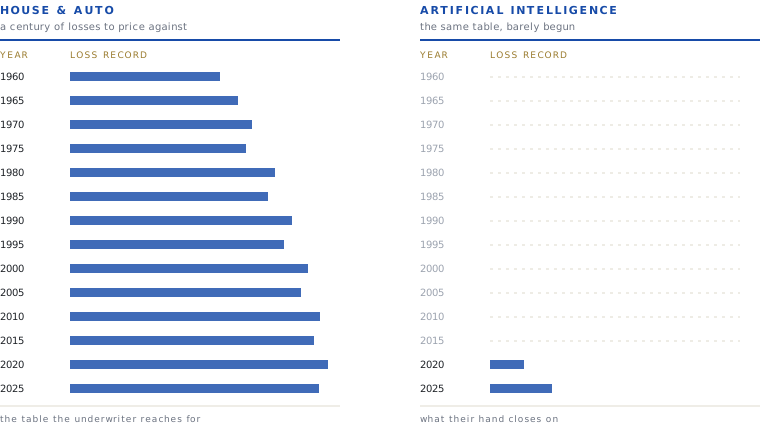
Why does the paperwork matter this much? Insurers usually set prices using loss history. Loss history is the record of what has gone wrong in the past, and how often. A century of car crashes tells an auto insurer roughly what a policy should cost. Wide use of AI is only a few years old. AI failures often surface slowly, buried inside decisions that looked fine at the time. The record an AI underwriter wants barely exists yet.
So insurers price the company instead of the risk. They look for proof that you understand what you have deployed. They want to see that you watch it while it runs. They want a plan for when it breaks. Governance, the rules and records that show how you control your AI systems, becomes the stand-in for the missing loss data.
The renewal questionnaire is the exam

The form you fill out to apply for coverage, and again each year to renew it, is where this becomes real. It looks like paperwork. It works like an exam. Every question asks for one document: a list of your AI systems, proof of human review, test results for bias and security, an incident plan, and often, proof that you follow a recognized standard.
Insurance researchers and carriers say this openly. The Geneva Association, an independent research group, finds that insurers are tightening standards. They check an applicant's AI systems and governance closely, more like a technical audit than a form.[1] Armilla, a carrier that writes this coverage, requires written governance policies with yearly testing. It requires a match to recognized standards.[2] Some carriers now treat a certification such as ISO/IEC 42001, an international standard for managing AI risk, as a factor in the price. It can open the door to coverage or better terms.[3] That practice is still new. As of mid-2025, no insurer was known to price it at all.[4]
There is a second reason to build the file early. What you write on an insurance application carries legal weight. It is not marketing copy. Say you claim a control you do not actually have, and a claim later depends on exactly that control. The insurer can point to the gap and deny the claim, at the worst possible moment. The safer path is to build the thing the question asks about, well before you have to answer it.
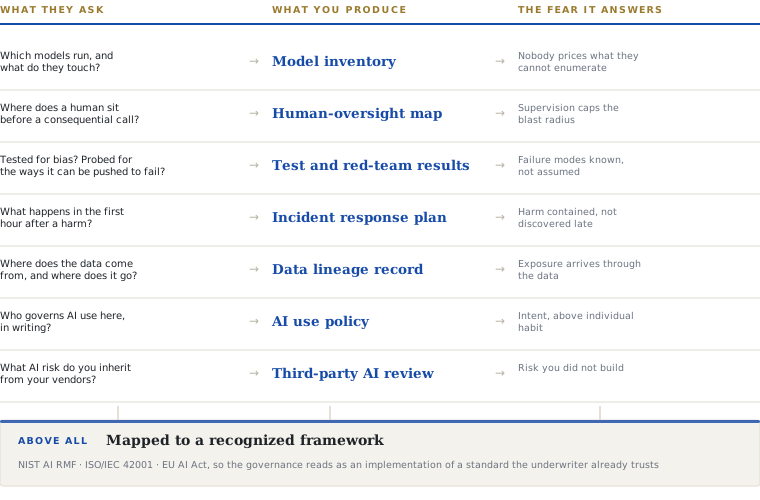
Handle this before the renewal form shows up, not after. The questionnaire only asks the questions. The governance file is the answer you show up with.
Works Cited
- 1The Geneva Association, Gen AI Risks for Businesses: Exploring the Role for Insurance (2 October 2025) https://www.genevaassociation.org/publication/digital-ai-transformation/gen-ai-risks-businesses-exploring-role-insurance-0
- 2Armilla AI, Covering AI: AI Insurance Becomes a Procurement Requirement (15 May 2026) https://www.armilla.ai/resources/covering-ai-ai-insurance-becomes-a-procurement-requirement
- 3Armilla AI, From ISO/IEC 42001 Certification to Insurable AI (17 December 2025) https://www.armilla.ai/resources/from-iso-iec-42001-certification-to-insurable-ai
- 4Joseph Breen, How effective AI governance can improve cyber insurance coverage , Deploy Securely (15 June 2025) https://blog.stackaware.com/p/cyber-insurance-ai-governance-iso-42001-nist-rmf
- 5Armilla AI, From Paper Policies to Real Oversight: How AI Governance Is Becoming Insurable (14 January 2026) https://www.armilla.ai/resources/from-paper-policies-to-real-oversight-how-ai-governance-is-becoming-insurable
- 6Lloyd's of London, Lloyd's Lab Accelerator alumni: Armilla AI https://www.lloyds.com/insights/lloyds-lab/programmes-and-initiatives/lloyds-lab-accelerator/alumni/armilla-ai
- 7David Powell, Head of Technical Underwriting, Understanding artificial intelligence risk in insurance products: the challenges , Lloyd's Market Association (13 April 2025) https://lmalloyds.com/understanding-artificial-intelligence-risk-in-insurance-products-the-challenges/