The History of Insurance · Part 2 of 3
Fire, Coffee, and Mathematics
How Insurance Became a Science
In a single century, from the Great Fire of London to the first actuary, insurance stopped being a shrewd merchant's instinct and became a discipline, with fire brigades, coffeehouse ledgers, and a mathematics that turned death itself into arithmetic.
Joel R. Singh
Underwritten
About 12 minutes
2026-07-23
Where Part 1 left us
By the close of Part 1, "The Oldest Bargain," risk had finally become a thing in its own right. In the ports of medieval Italy, an underwriter would take a fee up front and promise to make a merchant whole if his cargo never arrived, and that fee, the premium, had pried the danger of a voyage loose from the voyage itself, so that risk could at last be priced, traded, and pooled like any other commodity. What happened next is the story of how that loose, tradable thing was tamed. Over roughly a single century, insurance stopped being a shrewd merchant's instinct and became something closer to a discipline, with brigades and badges, coffeehouse ledgers, columns of the dead reduced to arithmetic, and inspectors who would walk your property before they agreed to cover it.
Our story continues with a pattern that we have seen before, another major disaster.
It begins with fire.
Smoke over London
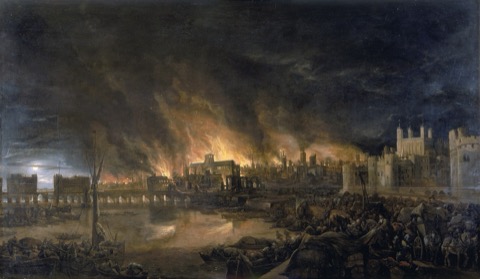
In the small hours of September 2, 1666, a fire caught in the shop of Thomas Farriner, the king's baker, on a cramped little street called Pudding Lane. London in that year was a city built almost entirely of timber and pitch, its upper stories leaning out over the lanes until neighbors could nearly shake hands across the gap, and a dry summer had left the whole of it ready to burn. It did. For four days the fire walked west through the old medieval core, jumping street to street faster than anyone could pull the buildings down ahead of it, and by the time the wind finally dropped it had consumed something on the order of thirteen thousand houses and left tens of thousands of Londoners with nothing at all. The diarist Samuel Pepys, in his diary entry of September 4, 1666, records burying his wine and his parmesan cheese in the garden to save them from the flames, which tells you, in one small human detail, how completely ordinary life came apart in those days.
Out of the fires of that particular catastrophe, and the ashes it left behind, emerged fire insurance as we know it today. The man who saw the opportunity most clearly was Nicholas Barbon, a physician by training who had turned to speculation and made a considerable fortune rebuilding the very city that had burned. Barbon began offering fire coverage in the years after the fire, and by 1680 he had formalized the whole enterprise as the Fire Office, run from premises behind the Royal Exchange. His firm was later known as the Phenix, for the phoenix stamped on its papers and its badges, a bird reborn from ashes, which was about as pointed a piece of branding as the seventeenth century produced.
The Great Fire · September 1666
A fire that began in the king's bakery on Pudding Lane burned for four days and destroyed roughly 13,000 houses across medieval London. The scale of the loss, and the demand for protection it created, gave rise to the first true fire insurance companies within the following decade.
What makes Barbon's Fire Office matter is what it did beyond simply collecting premiums and paying claims. Barbon organized his own fire brigade, and he handed every insured household a metal badge, a fire mark, to nail up on the front of the building. The mark was not decoration. When a fire broke out, the brigade would arrive, look for the badge, and know at a glance whether this was a house they were paid to save. An insurer who has to write the check when a building burns has every reason in the world to keep it from burning in the first place, and Barbon was among the first to act on that logic with men and buckets rather than with mere hope. Rival offices soon fielded their own brigades and their own marks, and the streets of London filled with competing badges. The system had its absurdities, and the brigades did not always cooperate across companies, but the underlying idea was sound and it has never left us. It is the direct ancestor of every modern insurer that offers you a lower premium for installing a sprinkler system or a monitored alarm.
Fire marks · 1680s onward
Barbon's insurer nailed a metal badge to every building it covered and ran its own brigade of watermen. If a fire broke out, the brigade checked the mark before it lifted a bucket. It is the first clear case of an insurer paying to prevent the very loss it had priced, and the origin of every "discount for a sprinkler" that follows.
The coffeehouse market
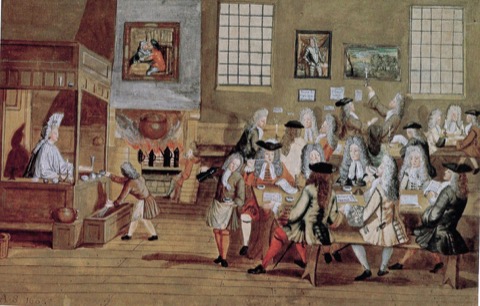
A few streets and a few years away, a different kind of insurance was taking shape over cups of a strange new drink. The first recorded mention of Edward Lloyd's coffeehouse, on Tower Street near the Thames, dates to February 1688. Lloyd himself never underwrote a single voyage. What he ran was a room, and it happened to be the room where the right people gathered. Coffeehouses in that era were the internet of their day, places where you went to hear the news, read the shipping lists, and do business, and Lloyd had the good sense to make his the one where the maritime trade congregated. Sailors and ship captains who had actually seen the far ports came through his door. So did the merchants who owned the cargo, and, most importantly, the men with money who were willing to stand behind a ship and bet on its safe return.
Here is how the market in that room actually worked. A merchant or a broker would write up the particulars of a voyage on a slip of paper: the ship, her master, the route she meant to sail, the cargo in her hold, the season. He would carry that slip around the room to the men of capital. A backer who liked the look of a given risk would read the terms, decide how large a share of it he was willing to carry, and then write his name on the slip, directly beneath the description of the risk, along with the portion he would take. That signature, written under the line, is the literal and unbroken origin of the word we still use today.
A backer would read the terms of a voyage and write his name under them. That signature beneath the line is the whole of the word: an underwriter is the person who takes the risk on.Lloyd's coffeehouse, 1688
The genius of the arrangement was in what happened when several men signed the same slip. No single backer had to swallow an entire ship and her cargo, a loss that could ruin even a wealthy man if she went down. Instead a dozen names might appear beneath one voyage, each taking a fraction, so that the peril of that single journey was scattered across a dozen private fortunes and no one of them was ever exposed to the whole. This is pooling again, the same ancient idea that split a Chinese merchant's rice across many boats, but now it was being done deliberately, in a room, with paper and ink and a shared understanding of the odds. Out of this loose gathering of independent backers grew Lloyd's of London, which is not a company in the ordinary sense even now but a marketplace, a place where members still combine their capacity to carry risks too large for any one of them to hold alone. Everything from ships to satellites to a pianist's hands has been insured there, and it all traces back to a coffee man who knew how to keep a good crowd.
The study of the dead becomes a science
For all its ingenuity, everything up to this point still rested on judgment. A Lloyd's underwriter priced a voyage by instinct sharpened on experience, and a fire office set its rates by feel. Nobody could yet say, with real numbers behind them, what a fair premium truly was. The thing that changed insurance from a craft into something like a science came, of all places, from a careful study of the dead.
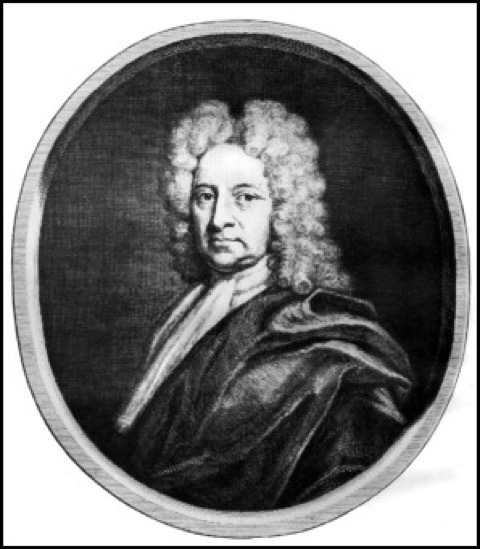
In 1693 the astronomer Edmond Halley, the same Halley whose name rides on the comet, published a remarkable paper in the Royal Society's Philosophical Transactions, "An Estimate of the Degrees of the Mortality of Mankind." Its subject was not the heavens. A Protestant pastor named Caspar Neumann had, for years, been recording every birth and every death in the Silesian city of Breslau, noting the age at which each person died, and those records had made their way across Europe and into the hands of the Royal Society. Halley took the raw columns of the Breslau registers, covering the years 1687 through 1691, and worked them into one of the first true mortality tables the world had seen: a single sheet that showed, for a group of people all born in the same year, how many could be expected to be still alive at every age that followed. It laid out plainly how the ranks thin as the years pass, and it did so from real recorded data rather than from guesswork.
That may sound like a dry accomplishment. It was one of the most consequential documents in the entire history of finance. Any single death is unknowable, a matter of luck and fate that no one can foresee. Across ten thousand lives, though, death becomes almost orderly, a smooth and predictable curve, and a curve is something you can build a price on. Halley even went the extra step and used his table to calculate what a fair price for a life annuity ought to be, an annuity being a promise to pay someone a fixed income for as long as they live. With his method in hand, the oldest question in the whole trade finally had a real answer instead of a hopeful shrug. You could now compute, rather than guess, how much to charge.
Any single death is unknowable. Across ten thousand lives it becomes almost orderly, a smooth curve, and a curve is something you can build a price on.Halley turns death into arithmetic
Halley's Breslau table · 1693
Working from birth and death records kept by the pastor Caspar Neumann in Breslau, Edmond Halley built one of the first mortality tables from real population data and published it through the Royal Society. It let an insurer calculate a fair premium on a human life for the first time. Death, across a large enough crowd, turned out to be arithmetic.
Building a fair price for a whole lifetime, however, took one more idea, and it came from an English mathematician named James Dodson. The problem Dodson saw was this. If you insure a person's life and simply charge each year exactly what that year's risk of death costs, the premium starts out cheap when the policyholder is young and healthy and then climbs, year after year, becoming crushingly expensive precisely when the person is old and can least afford it, which is the moment they most need the coverage to hold. Dodson's answer, worked out in the 1750s, was the level premium. You charge the same steady amount every year for the life of the policy. In the early years, when the true cost of the risk is low, the policyholder is deliberately overcharged, and that surplus, gathered up and left to grow with interest, becomes a reserve that quietly pays for the expensive later years when the risk is high. It is the mathematical engine behind essentially every whole-life policy sold in the centuries since.
Dodson himself did not live to see it built. He had actually approached an existing insurer, the Amicable Society, only to be turned away because they would not take anyone over the age of forty-five, and that rejection is part of what set the new idea in motion. Dodson died in 1757, but the men he had gathered around the plan carried it forward, and in 1762 the Society for Equitable Assurances on Lives and Survivorships opened in London, the institution history remembers simply as the Equitable. It was the first life insurer to price its policies on a genuine actuarial footing, using level premiums and mortality figures drawn from the town of Northampton, and it guaranteed the sum it would pay on death, which was a real novelty for the anxious buyer of the age. To run the mathematics at the heart of it, the Equitable's leader Edward Rowe Mores gave its chief officer a new job title, one no one had ever worn before. He called him the actuary.
A word on tontines
Alongside this sober line of progress ran a stranger and more colorful cousin, worth a short detour because it shows how much experimenting was going on with the arithmetic of human lives. In 1653 a Neapolitan financier in French exile named Lorenzo de Tonti proposed a scheme to Cardinal Mazarin as a way to refill a royal treasury drained by decades of war. His idea, which came to bear his name as the tontine, worked like a pooled annuity with a morbid twist. A group of people each paid into a common fund, and each drew a yearly income from it, and here was the catch: when a member died, his share was not paid out to heirs but redistributed among the survivors. The income of everyone still living therefore climbed as the group thinned, until the last survivor of them all was collecting the entire pool, a grim little lottery that ran on how long each person outlived the others. Tontines were used by governments to raise money and they had a long, checkered run before eventually falling out of favor, tangled up in scandal and the obvious perverse incentives. They belong to the family tree of life insurance as the eccentric relative, but they made the same essential point in their own dark way. A pool of human lives, taken together, behaves in ways you can count on even when any single life cannot.
The American story
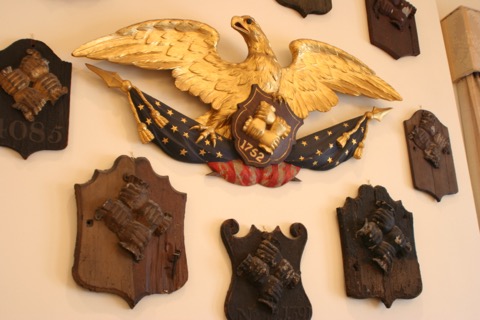
The threads of this century, loss prevention, mutual ownership, and hard-headed risk assessment, came together neatly on the other side of the Atlantic in the hands of a man who was constitutionally incapable of leaving a good idea unimproved. In 1752, Benjamin Franklin and a group of fellow Philadelphians founded the Philadelphia Contributionship for the Insurance of Houses from Loss by Fire. It stands today as the oldest property insurance company in the United States, and, remarkably, it is still writing coverage after more than two and a half centuries.
Two things about the way Franklin built it reach directly into the present. First, the Contributionship was organized as a mutual, meaning the policyholders themselves owned the company together, so that the people paying the premiums and the people who would collect on a loss were one and the same group, with no outside shareholders to answer to. That structure runs in a straight line back to the Roman burial societies of Part 1, ordinary people banding together to catch one another, and it is still how a great many insurers are organized today. Second, and more pointed for our purposes, the Contributionship treated risk assessment as a flat condition of coverage. It sent people to inspect the houses it was asked to insure. It set the price of each policy according to how the building was actually put together, favoring brick and slate over timber. And it flatly refused certain hazards, declining to cover houses it judged too dangerous at any price, most famously drawing back from homes crowded too near overhanging trees.
The Philadelphia Contributionship · 1752
Founded by Benjamin Franklin and neighbors as a mutual, owned by its policyholders, it is the oldest property insurer in the United States and still active. It inspected the homes it insured, priced by construction, and refused hazards it judged uninsurable. Coverage came with conditions from the very start.
That last habit is worth sitting with for a moment, because it is not a historical curiosity at all. The principle Franklin put into practice, that an insurer will inspect what it covers, price it by how well it is built, and simply walk away from a risk it cannot make safe, is exactly the principle at work when a modern insurer requires a factory to install fire doors or a hospital to encrypt its records before it will write the policy. And it is precisely the principle you meet again, in twenty-first-century clothing, when you sit down to read a policy covering the failures of an artificial intelligence system. Those policies increasingly demand documented testing, human oversight, and a written record of controls, and they will not pay out if you cannot show you had them. The inspector walking Franklin's Philadelphia streets in 1752 and the clause requiring an AI audit in 2026 are doing the very same job, which is refusing to insure a danger that the owner refuses to manage.
Where Part 3 goes
By 1762 the essential machinery of modern insurance was fully assembled. There was pooling, there was the priced premium, there was loss prevention with real incentives behind it, there was mutual ownership, and there was the actuary with the mathematics to hold it all together. Everything that came afterward is, in a sense, the same machine meeting new dangers and stretching to fit them.
And the dangers were about to multiply beyond anything a Genoese underwriter or a Philadelphia inspector could have pictured. The steam engine and the factory were coming, and with them a hunger for whole new kinds of coverage. Machines would explode, and someone would have to insure the boiler. Then the automobile would arrive and put a fast, heavy, dangerous machine into the hands of ordinary people, and an entire industry would rise to pool the wreckage. In our own time the risks turned invisible, moving from the physical world into the digital one, and insurers had to learn to price a data breach and a ransomware attack. Now the newest risk of all does not merely break down or catch fire. It makes decisions, and sometimes it makes them wrong. In Part 3, "Insuring the Machine Age," we follow the oldest bargain from the factory floor to the automobile to the server room, and finally to the strange and urgent question of who stands behind an artificial intelligence when it fails.
Sources & Notes
- The Great Fire of London, Thomas Farriner, Pudding Lane, and the scale of roughly 13,000 houses lost: the inscription on The Monument to the Great Fire of London, and the London Fire Brigade history of the fire.
- Samuel Pepys burying his wine and parmesan cheese: Pepys, The Diary of Samuel Pepys, entry of 4 September 1666 (Latham and Matthews, eds.). Text at pepysdiary.com.
- Nicholas Barbon and the Fire Office: Insurance Hall of Fame and the Insurance Museum. The formal Fire Office is dated to 1680–81; Barbon's earlier fire-cover activity in the years after the Great Fire is documented but not by a surviving 1667 deed.
- Edward Lloyd's coffeehouse, first recorded mention February 1688 on Great Tower Street: London Gazette, 18–21 February 1688/9, and the Lloyd's Register historical record.
- Edmond Halley's mortality table: Halley, "An Estimate of the Degrees of the Mortality of Mankind, drawn from curious Tables of the Births and Funerals at the City of Breslaw," Philosophical Transactions of the Royal Society 17(196):596–610, 1693. doi:10.1098/rstl.1693.0007. See also J. Ciecka (DePaul University) on Halley's annuity valuation.
- Lorenzo de Tonti, the 1653 tontine proposal to Cardinal Mazarin: K. McKeever, "A Short History of Tontines," Fordham Journal of Corporate and Financial Law 15(2), 2010.
- James Dodson, the level premium, the Amicable Society's age-45 refusal, and Dodson's death in 1757: contemporary account in the Journal of the Institute of Actuaries.
- The Society for Equitable Assurances on Lives and Survivorships (the Equitable), founded 1762, and its use of Northampton mortality data: the Equitable's Deed of Settlement (1765, Google Books).
- Edward Rowe Mores coining "actuary" (1762): Mores, A Short Account of the Society for Equitable Assurances on Lives and Survivorships.
- The Philadelphia Contributionship for the Insurance of Houses from Loss by Fire, founded 1752, oldest property insurer in the United States: company history at 1752.com.
The long arc
Six milestones from the Great Fire to the first actuary
Not quite a single century, from the flames that gave London its fire offices to the London society that hired a mathematician, called him an actuary, and priced a human life on real numbers for the first time.
-
1666
The Great Fire of London
A fire from a Pudding Lane bakery burns roughly 13,000 houses over four days. The catastrophe that made ordinary people demand fire insurance.
-
1680
Barbon's Fire Office
Nicholas Barbon offers fire coverage in the years after the Great Fire and formalizes the Fire Office by 1680, with its own brigade and metal fire marks. Loss prevention is born.
-
1688
Lloyd's coffeehouse
Edward Lloyd's coffeehouse gathers the maritime trade. Backers write their names under each voyage's risk, giving us the word "underwriter."
-
1693
Halley's mortality table
Edmond Halley builds one of the first mortality tables from Breslau's records. Death across a crowd becomes a curve you can price.
-
1752
Philadelphia Contributionship
Benjamin Franklin's mutual, the oldest US property insurer, inspects homes, prices by construction, and refuses hazards it cannot make safe.
-
1762
The Equitable, and the actuary
The Equitable prices life policies on level premiums and real mortality data, and coins a new job title for the mathematician behind it: the actuary.
The History of Insurance · Part 2 of 3
Part 2 of 3. Part 3, "Insuring the Machine Age," follows the oldest bargain from the factory floor and the boiler to the automobile, the data breach, and the strange new question of who stands behind an artificial intelligence when it fails.
Continue · Part 3 of 3
Insuring the Machine Age: From the Factory Floor to Artificial Intelligence
The steam boiler, the automobile, the data breach, and the algorithm: how the oldest bargain stretched to cover each new machine, all the way to the artificial intelligence that makes its own decisions and sometimes makes them wrong.
Part 3 is forthcoming. This link will resolve once "Insuring the Machine Age" publishes.