Guarantee or Indemnity, in brief
The short version of Guarantee or Indemnity. Four minutes, same sources.
Joel R. Singh
Underwritten
2026-09-16
Two products are sold as AI insurance. They answer different questions. One pays when your AI misses a number it promised. The other pays when your AI harms someone and that person comes after you. Buying the wrong one is easy, because the label on the tin is the same.
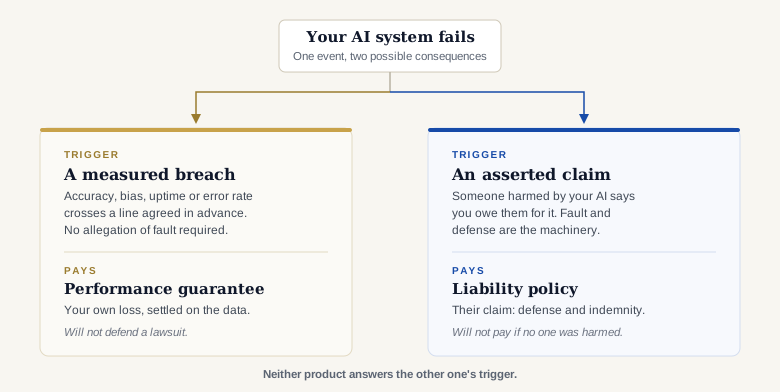
Start with the performance guarantee, sometimes called a warranty. It pays when the AI fails to perform. The trigger is a measured breach of a threshold agreed in advance: accuracy, bias, uptime, error rate. Nobody has to claim you were careless. The loss is your own money. A vendor who promised a client 95 percent accuracy and delivered less is out whatever it costs to make that promise good. Munich Re's aiSure, sold through Mosaic, works this way, and so does Armilla Guaranteed. Settlement follows the agreed metric rather than an argument about who was at fault.
Here is what a guarantee will not do. It will not defend a lawsuit, answer a regulator, or pay a third party your AI harmed. No claim, no defense, no indemnity.
| Exposure | Vouch | Relm | CFC |
|---|---|---|---|
| Hallucination / harmful output | ● | ● | ● |
| IP infringement | ● | ● | · |
| Bias & discrimination | ● | ● | · |
| Regulatory defense | ● | · | · |
| Privacy | · | ● | · |
| Bodily injury & property damage | · | ● | · |
| Civil fines, where insurable | · | ● | · |
| Model drift | · | · | ● |
The liability policy does the opposite job. It waits for a claim. A customer, a member of the public, or a regulator asserts that your AI caused them harm and that you owe them for it. Fault and defense are the machinery. Testudo, Vouch, Relm and CFC all sell in this register, reaching exposures such as hallucinated output, IP infringement, bias, privacy and bodily injury.
And here is what a liability policy will not do. It will not pay you because the model underperformed when nobody was harmed and no claim was made. Your own first-party loss sits outside it.
The underwriting tells you what each product is really about. A guarantee underwriter studies the model: how it behaves, how it was tested, what threshold it can credibly hold. A liability underwriter studies you: your sector, your use case, your governance, and the harms a claimant could plausibly assert. Same technology, two different questions.
Which product you need depends on which loss would actually hurt you, and for many businesses the answer is both. A vendor selling AI to enterprise customers has made performance promises it may need to backstop, and it also faces the risk that its model harms one of those customers' own clients. A deployer running someone else's model mostly faces the second risk, because the performance promise was the vendor's to make and the vendor's to insure.
One more reason the line matters. Proof works differently on each side. A guarantee settles on performance data you can measure. A liability claim settles the way claims have always settled: investigate, defend where defensible, pay where not. If you expect the first and buy the second, you will be waiting for a payout that has no trigger.
What to do this week
- Name the loss that would actually hurt you. Write down the single AI failure that would cost you most. Money you lose yourself, or money someone demands from you.
- Check which trigger your quote uses. Find the word that starts the cover. A measured threshold, or a claim asserted against you.
- Read what it excludes, not just what it covers. A guarantee that cannot defend a lawsuit is doing its job correctly. Know that before you need it.
- Ask who the underwriter is studying. If the questions are all about your model, you are buying a guarantee. If they are about your sector and governance, you are buying liability.
- If you are a vendor, price both. You carry a performance promise and a third-party risk at the same time.
Drawing this line is not about steering you toward one product. It is about making sure that whichever one you sign, you signed it knowing which loss it answers and which loss it leaves on the table.
Works Cited
- 1Encyclopaedia Britannica — Insurance https://www.britannica.com/money/insurance/Historical-development-of-insurance
- 2Testudo — GenAI Liability Insurance (third-party claims from AI-generated outputs; responds where CGL may not) https://www.testudo.co/insurance
- 3Mosaic Insurance — aiSure (breach of a predefined performance threshold triggers payout; no negligence allegation needed; parametric-style; settled on measurable performance data) https://www.mosaicinsurance.com/underwriting/aisure/
- 4Munich Re — Insure AI / aiSure (AI performance guarantee; backstop for AI vendors' contractual performance promises; underwriting centred on the model) https://www.munichre.com/en/solutions/for-industry-clients/insure-ai.html
- 5Swiss Re — What is parametric insurance (payout on a defined, measurable parameter rather than proven indemnified loss) https://corporatesolutions.swissre.com/insights/knowledge/what_is_parametric_insurance.html
- 6Armilla — AI Insurance (affirmative AI liability policy, and a separate Armilla Guaranteed performance warranty paying on contractual KPI failures such as accuracy or bias thresholds) https://www.armilla.ai/ai-insurance
- 7Chaucer — Chaucer and Armilla AI launch Vanguard AI coordinated insurance structure (affirmative AI liability underwritten by Lloyd's capacity) https://www.chaucergroup.com/news/press-release-chaucer-and-armilla-ai-launch-vanguard-ai-coordinated-insurance-structure
- 8Vouch — AI Insurance (AI E&O for hallucinations and misleading outputs, algorithmic bias, regulatory defence, IP infringement; via the Corix / Hiscox partnership) https://www.vouch.us/technology/ai
- 9Relm Insurance — PONTAAI (excess difference-in-conditions wrap for deployers whose programs exclude AI; professional negligence, IP, discrimination, privacy, bodily injury and property damage, and insurable civil fines for AI-regulation violations) https://relminsurance.com/relms-pontaai-solution-ai-insurance-coverage-beyond-existing-liability-programs/
- 10CFC — CFC responds to customer demand for affirmative AI cover (affirmative AI embedded across core commercial lines; addresses hallucinations, AI-generated content, and model drift) https://www.cfc.com/en-us/knowledge/news/2026/06/cfc-responds-to-customer-demand-for-affirmative-ai-cover/
- 11ElevenLabs — ElevenLabs secures first-of-its-kind AI agent insurance (AIUC-1 certification across security, safety, reliability, privacy, and accountability, bundled with agent insurance) https://elevenlabs.io/blog/aiuc-announcement
- 12Coalition — Coalition adds new affirmative AI endorsement to cyber policies (covers AI as an attack vector, including deepfake reputational harm; does not cover liability for the insured's own AI outputs) https://www.coalitioninc.com/announcements/coalition-adds-new-affirmative-ai-endorsement-to-cyber-policies
- 13HSB (a Munich Re company) — Introducing AI Liability Insurance for Small Businesses (lawsuits from use of AI; bodily injury, property damage, and advertising injury from AI-generated content; fills gaps GL excludes) https://www.munichre.com/hsb/en/press-and-publications/press-releases/2026/2026-03-18-introducing-ai-liability-insurance-for-small-businesses.html